


As we previously reported, most New York State employers must have opioid antagonists available at work by December 13, 2026. The new law applies to all employers that are federally required under the Occupational Safety and Health Act (OSHA) to keep first-aid supplies readily available for treating injured employees. The law also directed the New York State Department of Labor (NYSDOL), in coordination with the New York State Department of Health (NYSDOH), to issue regulations addressing the appropriate number of opioid antagonists, training, use and other implementation issues. NYSDOL released its proposed regulations on September 23, 2026.
The proposed rules would require covered employers to take several steps before the law takes effect on December 13, 2026:
Although some questions remain unanswered, the proposal would give covered employers significant discretion in implementing the new requirements.
The proposal does not establish a minimum number of doses. Instead, each covered employer would need to provide a “sufficient number” of opioid antagonists so an administrator can “respond quickly” to a suspected overdose. In deciding what is sufficient, an employer would consider:
This site-specific standard gives employers flexibility to determine an appropriate supply for each location. At the same time, the employer bears ultimate responsibility for this decision—and it is best to over-supply than under-supply.
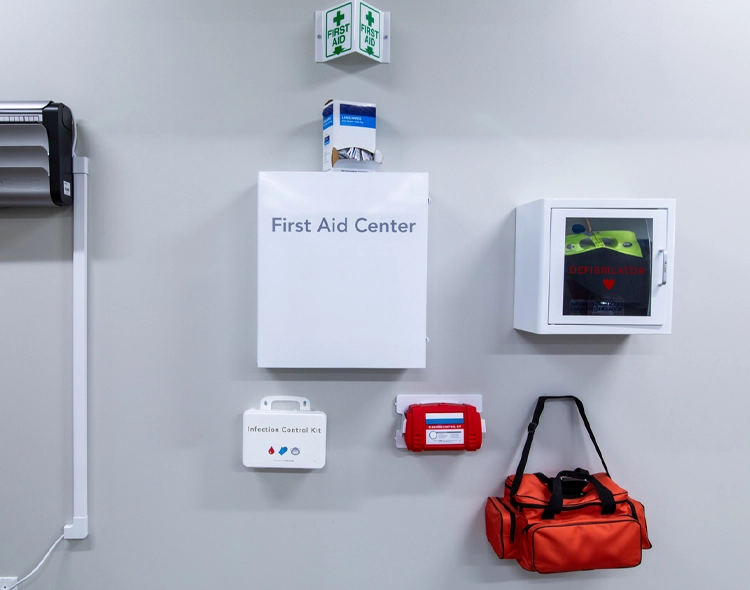
Under the proposed rules, opioid antagonists generally would need to be stored in “easily accessible areas.” A person retrieving the medication should not have to pass through “several doorways, hallways, and/or stairways.” When selecting a location, employers would need to consider the placement of automated external defibrillators and other first-aid supplies, the workplace layout, the location’s centrality and visibility, security restrictions, and the risk of tampering, damage, removal or theft.
The rules discourage (but don’t outright prohibit) storing the primary supply in a locked room or restricted area. Restricted storage would be permitted when an employer has a reasonable security- or safety-based concern and takes measures to ensure quick access. Employers would also need to clearly inform employees where the supply is kept so trained administrators can locate it quickly. The medication would need to remain sealed in its original manufacturer’s packaging and be stored with either the manufacturer’s instructions or specified government instructions.
When multiple employers share a workplace, the proposed rules would allow them to comply jointly. In such cases, however, the employers must memorialize their plan for joint compliance and make it available to the NYSDOL upon request.
Covered employers would need to inspect workplace supplies regularly to confirm that opioid antagonists have not expired, been tampered with or been removed. They would need to replace expired, tampered-with, removed or missing medication as soon as they become aware that replacement is necessary. Used medication would need to be replaced promptly, and used or expired medication would need to be disposed of properly. The proposal does not specify an inspection schedule or disposal method.
The proposal would direct covered employers to make reasonable efforts to recruit employee volunteers for training. Per the proposal, employers “may choose to ensure that all employees become trained,” but are not required to train everyone. However, under the proposed regulations, employers must ensure that there is always at least one employee in the workplace during business hours who has completed training in the administration of opioid antagonists. Given this requirement, employers would be wise to train most, if not all, employees.
The goal is to have trained employees available to support a rapid response to a suspected overdose. Training would need to align with NYSDOH guidance and address:
The proposal would not require any employee to volunteer, nor would it permit an employer to compel an employee to administer an opioid antagonist.
The public comment period is open. Employers may wish to review the proposal with counsel and consider submitting comments. Covered employers should begin to stockpile opioid antagonists and train employees before December 13, 2026.
Additional Assistance
For further assistance, please contact any of the attorneys on our Labor and Employment Practice Team or the Phillips Lytle attorney with whom you have a relationship.



Receive firm communications, legal news and industry alerts delivered to your inbox.
Subscribe Now