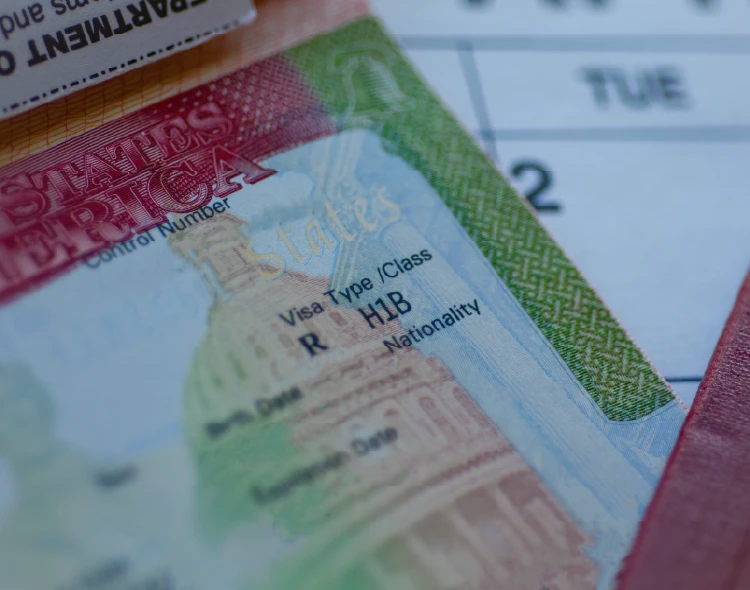



On September 18, 2026, the Trump administration published a Proclamation extending Proclamation 10973 (Restriction on Entry of Certain Nonimmigrant Workers) until midnight on September 21, 2027.
Proclamation 10973 was published in September 2025 and required that all H-1B visa petitions filed on behalf of employees located outside of the U.S. be accompanied by a $100,000 fee. Failure to submit this fee would result in a bar to the sponsored employee’s entry to the U.S. The administration’s justification for this one-year extension is to further counteract perceived abuses of the H-1B program, as well as high unemployment for college graduates, wage suppression and fraud, all of which threaten the U.S.’s labor market and national interests. The $100,000 fee will expire on September 21, 2027, absent further extensions.
It is worth noting that the U.S. District Court for the District of Massachusetts ruled on June 8, 2026, that the $100,000 H-1B fee was an unlawful tax. The federal government subsequently appealed this ruling and requested a pause on the decision, which was denied by the U.S. Court of Appeals for the First Circuit on July 24, 2026. As federal courts have already struck down this fee and prohibited immigration agencies from assessing its inclusion in H-1B petitions, it is unclear whether the administration’s extension of Proclamation 10973 will be enforced at this time. In the meantime, employers should continue to abstain from filing H-1B petitions on behalf of employees currently located outside of the U.S. to avoid encountering issues associated with the $100,000 fee.
The Trump administration placed further scrutiny on the H-1B program in a separate Executive Order also published on September 18, 2026, titled “Enhancing Program Integrity and Interagency Coordination in the Administration of the H-1B Nonimmigrant Visa Program.” According to the Executive Order, the Secretaries of State, Labor and Homeland Security may now assess whether H-1B employers have directly or indirectly engaged in layoffs within the previous year that negatively impact similarly situated U.S. workers, or that plan future layoffs of such workers, when assessing labor condition applications, H-1B petitions and visa applications, and the entry of H-1B nonimmigrants into the U.S.
Additionally, these Secretaries may now coordinate and consult with the Secretary of Commerce, Secretary of Education and Administrator of the Small Business Administration to obtain relevant wage, employment, academic, industrial or other economic information that could be used to assess employers’ compliance with applicable H-1B regulations. Pursuant to INA § 212(n)(2)(G), the Executive Order also allows the Secretary of Labor to begin reviewing data related to previously submitted labor condition applications (LCAs) to investigate and determine whether further action is warranted against sponsoring H-1B employers. These investigations may begin within 30 days of the Executive Order’s publication.
It should be noted that while the U.S. Department of Labor’s H-1B regulations contain non-displacement provisions prohibiting the hiring of H-1B workers following a layoff, these provisions apply only to H-1B-dependent employers, not to all H-1B employers. An employer is considered H-1B dependent if:
Due to increased agency cooperation and analysis of both past and present labor condition applications, the Executive Order will certainly result in increased scrutiny on all H-1B petitions moving forward. This scrutiny is likely to have broad application and may affect both H-1B employers and employees at each step of the H-1B filing and adjudication process. H-1B employers, therefore, must ensure that they diligently and accurately document all hiring and termination practices in the event that layoff-related information is requested by U.S. Citizenship and Immigration Services as part of Requests for Evidence, which are likely to be issued more frequently to assess compliance.
Additional Assistance
For more information, please contact a member of our Immigration Practice Team or the Phillips Lytle attorney with whom you have a relationship.
Receive firm communications, legal news and industry alerts delivered to your inbox.
Subscribe Now