
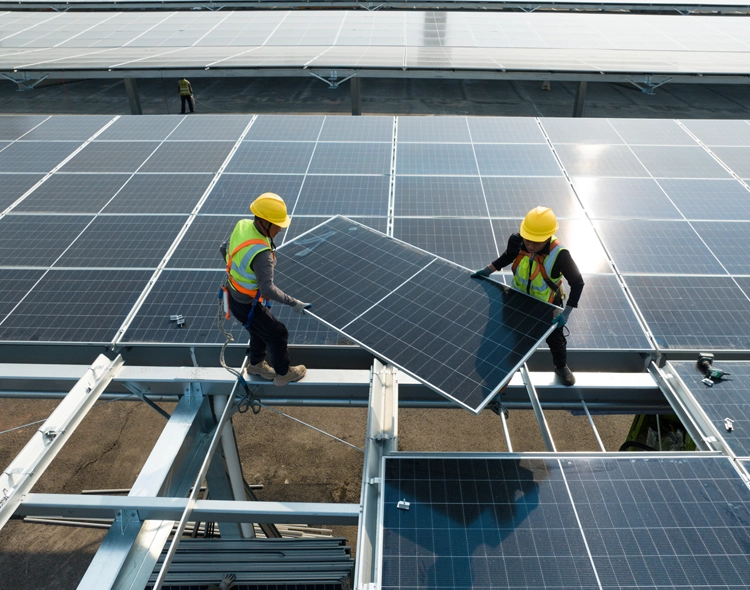

New York State is set to act in two key ways to support solar energy development as a result of the recently passed 2026-27 fiscal year state budget. The budget, which was approved by the State Legislature and recently signed into law by Governor Kathy Hochul, will:
These actions are likely to provide solar energy developers with greater cost certainty and improved project siting optionality. However, lawmakers chose not to increase the statewide distributed solar goal from 10 GW by 2030, which has already been met.
The NY-Sun program, administered by the New York State Energy Research and Development Authority (NYSERDA), deploys funds to encourage solar energy development across the state. To date, NY-Sun has relied exclusively on ratepayer funds, raised from fees such as the System Benefits Charge on consumer energy bills. As part of the budget’s $1 billion Sustainable Futures Program allocation, NY-Sun will now receive $200 million in taxpayer funds to boost solar energy development.
NYSERDA will develop a spending plan to determine how the money will be allocated within the NY-Sun program. Solar developers and the wider solar energy stakeholder community should monitor and engage in the development of the spending plan to ensure the funds are allocated in ways that would best encourage solar energy development in New York.
With the stated purpose of “increasing distributed solar energy capacity, reducing interconnection delays, and lowering interconnection costs,” the budget includes two key provisions regarding grid interconnection, which were taken from the proposed Accelerate Solar for Affordable Power Act.
First, the legislature directs the PSC to initiate a proceeding that requires every electric corporation to (a) file a report that details the costs of distribution upgrades associated with past distributed energy resources (DER) interconnections and (b) track actual costs of distribution upgrades for such future interconnections. In addition, the proceeding will consider proposals—and have the authority to issue orders—to create greater cost-certainty for distribution upgrades.
Second, to promote an alternative to traditional grid infrastructure upgrades, the legislature directs the PSC to initiate a proceeding that requires every electric corporation to develop proposals for a flexible interconnection program. Flexible interconnection is the use of smart-grid technology to monitor and actively manage DERs (e.g., solar energy generation and energy storage systems, which can help DERs interconnect in areas with limited or no remaining hosting capacity). Some New York electric utilities, including Avangrid and National Grid, have already implemented flexible interconnection pilot programs. Solar developers and the wider solar energy community will have the opportunity to shape the rollout of flexible interconnection through forthcoming public comment periods under this proceeding.
The interconnection provisions promise to significantly improve how solar energy projects come online. Combined with the $200 million in support to the NY-Sun program, the new state budget should be viewed as a positive step for solar energy developers.
Additional Information
For more information, please contact a member of our Energy and Renewables Industry Team, Environmental Law Practice Team, or the Phillips Lytle attorney with whom you have a relationship.
Receive firm communications, legal news and industry alerts delivered to your inbox.
Subscribe Now