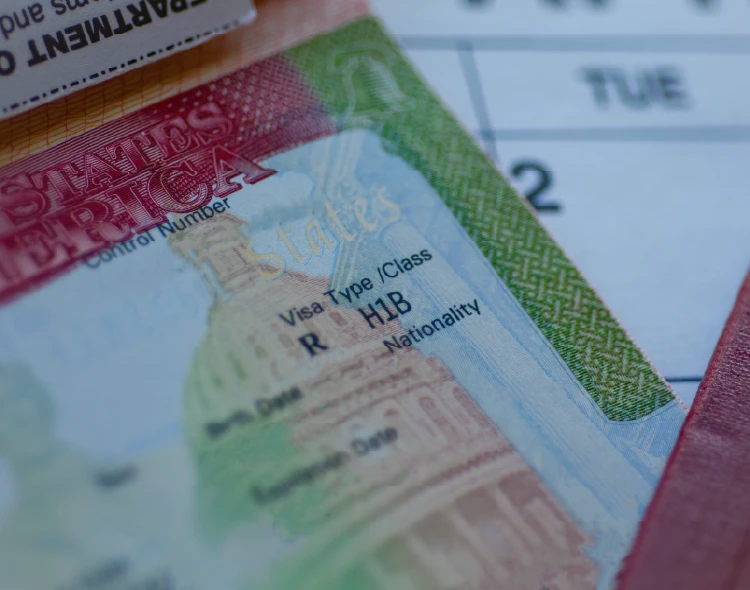


On March 4, 2026, U.S. Citizenship and Immigration Services (USCIS) will open the online registration portal for submission of the FY2027 H-1B lottery registrations.1 The registration window will remain open until March 19, 2026. USCIS will conduct the H-1B lottery and notify petitioners or their legal counsel of the selection results by March 31, 2026. Those who are selected in the initial round of the lottery will have from April 1, 2026, until June 30, 2026, to file H-1B petitions. If approved, the foreign national beneficiaries will be able to start work in H-1B status on or after October 1, 2026.
This year’s H-1B lottery will be different from prior lotteries in that USCIS is introducing a new weighted selection process to increase the odds of selection for the highest paid beneficiaries. In addition, this year’s lottery will be uniquely impacted by a 2025 H-1B Proclamation by the Trump administration.
On September 19, 2025, President Trump issued a Presidential Proclamation imposing a $100,000 surcharge on the filing of certain H-1B petitions. Agency guidance subsequently clarified that this surcharge would apply only to H-1B beneficiaries who are outside the U.S. at the time the H-1B petition is filed on their behalf, or on whose behalf a requested change of status or extension of stay has been denied. The Proclamation states in Section 1 that it, “shall expire, absent extension, 12 months after the effective date,”2 or on September 20, 2026.
It is clear that the $100,000 fee will be applied to any case where the beneficiary is outside of the U.S. at the time of filing. The plain text of the Presidential Proclamation indicates that such petitions will be denied if they are not submitted together with proof of the $100,000 fee payment.
It is possible that some people who are inside the U.S. at the time of filing will still be subject to the fee if their change of status request is denied. Immigration regulations at 8 C.F.R. §248.1(a)[PL1.1][PL1.2] provide that a change of status may only be granted to someone who “is continuing to maintain his or her nonimmigrant status.” Per the USCIS Policy Manual, Chapter 4, USCIS decisions on whether to grant or deny a change of status are discretionary.
When USCIS adjudicates an H-1B petition that includes a request for a change of status, they must make two separate adjudications. First, the agency adjudicates whether the beneficiary is eligible for H-1B status, and second, the agency adjudicates whether the beneficiary is eligible for the requested change of status. It is possible for USCIS to approve an H-1B petition and simultaneously to deny a change of status request, if the agency determines that the beneficiary failed to maintain his or her prior nonimmigrant status. The USCIS Policy Manual refers to this type of adjudication as a “Split Decision.” When a Split Decision is made, USCIS issues an approval notice for the H-1B petition and a Denial Decision for the change of status request.3 It should be noted that a USCIS decision denying an H-1B petition can be appealed, whereas a denial of a change of status request cannot be appealed because it is discretionary.4
If USCIS issues a Split Decision on a cap H-1B petition for someone who is currently in the U.S. because the individual is found to have violated his or her prior status in some way, it means that individual will be immediately out of status as of the decision date, and will need to leave the U.S., go to their home country5 to apply for an H-1B visa based on the approved petition, and then return to the U.S. upon issuance of the visa. However, this departure from the U.S. will trigger the requirement to pay the $100,000 H-1B fee before being permitted to return to the U.S.
Many, if not most, H-1B lottery registrants are filed on behalf of international students who seek a change of status to H-1B following graduation. International students seeking a change of status may be vulnerable to more discretionary denials of their change of status requests, thus subjecting their employers to the $100,000 fee. The following scenarios are at particular risk for a discretionary denial:
There are several colleges and universities throughout the U.S. who offer master’s degree programs that require immediate use of CPT at the master’s level and that specifically cater to those international students who have not been selected in the H-1B lottery and who are looking for a way to remain legally in the U.S. and to continue working. The first semester CPT programs at the master’s level provide a way to do this, which is consistent with the F-1 regulations.
While first semester CPT master’s programs comply with regulatory requirements, they are nevertheless heavily scrutinized by USCIS. Historically, the risk in attending one of these schools and later seeking a change of status to H-1B once selected in the lottery has been relatively low, as the worst case scenario would be a discretionary Split Decision, requiring the beneficiary to return to their home country to apply for an H-1B visa, after which they could return to the U.S. to take up H-1B status. Given the $100,000 H-1B Proclamation, however, those who are denied a change of status in a Split Decision will not be able to receive an H-1B visa or return to the U.S. until the fee has been paid.
To date, no guidance has been issued to indicate how the September 20, 2026 sunset date for the Proclamation will impact this year’s cap filings. The Proclamation requires submission of proof that the $100,000 fee has been made at the time of filing for those who are physically outside the U.S. at the time of filing. For those cases where the beneficiary is inside the U.S. and the petitioner requests a change of status on his or her behalf, the fee payment would not be required up front but would be requested in a Request for Evidence (RFE) when USCIS denies the change of status request. This raises the question: What happens if the RFE response is due after September 20 and the Proclamation has expired? This is a realistic scenario because cap cases can be filed as late as June 30, adjudications take months, and petitioners are typically given 87 days to respond to an RFE.
It is possible that the Proclamation will be extended through another Proclamation, and then the answer will be clear: the fee still applies. But if the Proclamation is not extended, it is not clear whether USCIS will opine that the fee applies based on the fact that the Proclamation remained in effect at the time that the H-1B petition was filed, or whether, because the Proclamation is framed as a ban on entry to the U.S. absent payment of the fee, it will not apply. We hope to see additional guidance from USCIS on this issue.
Additional Assistance
For more information, please contact a member of our Immigration Practice Team or the Phillips Lytle attorney with whom you have a relationship.
Receive firm communications, legal news and industry alerts delivered to your inbox.
Subscribe Now