
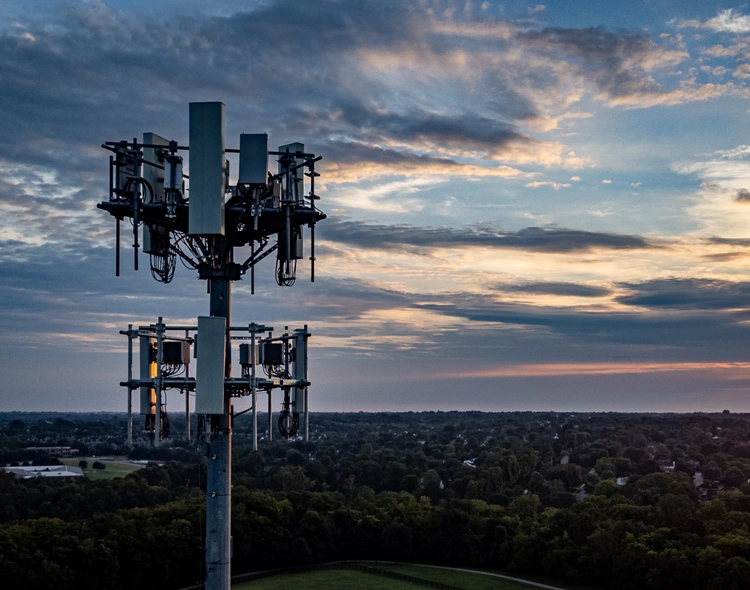


An auction for 65 MHz of AWS-3 mid-band wireless spectrum has been scheduled for June 2, 2026, offering fixed and mobile wireless providers access to licenses across the 1695-1710 MHz band for unpaired cellular uplink, 1755–1780 MHz and 2155–2180 MHz bands for paired uplinks, and 2155-2180 MHz band for base station and fixed wireless.1
The framework for AWS-3 Auction 113 was established after the Federal Communications Commission (FCC) released a Notice of Proposed Rulemaking (NPRM) on February 28, 2025, to initiate the auction process.2 The AWS-3 Auction 113 was authorized by Congress in December 2024 and was required to be completed within 18 months of December 23, 2024.3 The proceeds from Auction 113 were directed to provide $3.3 billion in additional funding to the Rip-and-Replace Program (known as the Secure and Trusted Communications Networks Reimbursement Program) and $220 million to fund regional technology hubs from the Stevenson-Wydler Technology Innovation Act of 1980.4 The AWS-3 Auction 113 is intended to complete the 2014 AWS Auction 97, which sold licenses for other AWS-3 bands. Auction 97 did not result in the sale of all the AWS-3 bands because of selective defaults by two winning bidders.5
On March 11, 2025, the FCC issued a public notice seeking comment on Auction 113 proposing an ascending clock auction format—a multiple-round auction format with bidding for specific licenses rather than generic blocks of spectrum.6 In an ascending clock auction, prices increase in rounds until demand no longer exceeds supply. In each round, the FCC announces a start price for the round and a higher clock price for each license. In each round, the FCC will announce a start-of-round price and a higher clock price for each license; bidders indicate their demand (0 or 1) at prices between these values, including intraround bids that allow bidders to specify the price to drop or add demand. The auction uses a simultaneous stopping rule. Bidding ends when, after a round’s bid processing, no license has excess demand and winning bids are determined by the final round in which each license has a single bidder still demanding it. Bidders indicate their demand at prices between set values. The system uses activity and eligibility rules: bidders must be active on a large percentage (initially 95%, within a 90–100% range) of their bidding eligibility each round, or their eligibility will be reduced, enforcing early and consistent participation. Clock price increments start at 10% with authority to adjust between 5% and 30% and are capped in absolute dollar terms (initial cap $50 million per round) to manage auction pace without overshooting market-clearing prices. The auction uses a simultaneous stopping rule. Bidding ends when, after a round’s bid processing, no license has excess demand and winning bids are determined by the final round in which each license has a single bidder still demanding it. Winning bids are determined by the final round in which each license has a single bidder still demanding it.
On July 25, 2025, the FCC issued its Report and Order, setting Auction 113.7 Then, on December 18, 2025, the FCC issued its Public Notice for the Auction of Advanced Wireless Services (AWS-3) licenses for Auction 113.8 The Public Notice set key deadlines for Auction 113. The Public Notice defined upfront payments and bidding eligibility based on MHz pop and bidding units. These are locked in and cannot be increased after the payment deadline. The Public Notice further highlighted that AWS 3 licensees would be sharing spectrum with federal incumbents in the 1695–1710 and 1755–1780 MHz bands and would be required to coordinate with the federal spectrum holders in those bands. Winners, the Public Notice explained, may need to protect or relocate non federal incumbents in the 2155–2180 MHz band. As required by the Report and Order, the Public Notice explained that the FCC would use a descending clock format with strict activity rules, anti collusion and limited information requirements. Following the auction, participants would be required to adhere to standard post auction obligations, including making timely down payments and submitting auction long form applications (Forms 601 and 602), with potential bidding credits and default penalties.
The Public Notice set explained that the AWS 3 bands would be subject to federal and non federal incumbents. Many licenses involve mandatory sharing and coordination obligations. In the 1695–1710 MHz and 1755–1780 MHz bands, AWS 3 operations must share with federal systems in defined geographic protection zones. License holders must not cause harmful interference to federal incumbents relocating under approved transition plans. The holders must accept interference from some federal operations until the National Telecommunications and Information Administration (NTIA) terminates the federal authorizations. The 2155–2180 MHz band is cleared of federal users but still contains non federal microwave and Broadband Radio Service (BRS) incumbents, which AWS 3 licensees may have to protect, relocate or share relocation costs. AWS 3 licensees in 1695–1710 and 1755–1780 MHz bands must also coordinate operations with federal agencies prior to operating in protection zones through zone based coordination procedures refined in a joint FCC/NTIA coordination public notice.
Upfront payments serve as refundable deposits that establish the maximum bidding eligibility a bidder has in terms of “bidding units.” Upfront payment amounts are calculated primarily based on dollars per MHz pop: for paired blocks, $0.005/MHz pop in markets under 300,000 population, $0.01/MHz pop for 300,000–1,000,000, and $0.025/MHz pop for 1,000,000 or more, while unpaired licenses are set at $0.005/MHz pop, with a minimum of $500 per license; each $100 of upfront payment corresponds to one bidding unit. During Auction 113, the FCC will apply its standard “limited information” and anti collusion rules. Section 1.2105(c) prohibits certain communications about bids and bidding strategies among competing applicants from the short form deadline until the down payment deadline. The Public Notice details which entities are covered, the scope and duration of the ban, and the duty to report prohibited contacts.
While the application deadline (February 11, 2026) has passed, the other upcoming important dates included in the Public Notice are:
As the auction approaches, potential bidders must prepare the FCC Form 159 and prepare for the mock auction to ensure eligibility for the bidding process and to position themselves for a successful auction. It is recommended that bidders employ consultants and attorneys offering spectrum auction guidance in advance of these dates and requirements.
Receive firm communications, legal news and industry alerts delivered to your inbox.
Subscribe Now