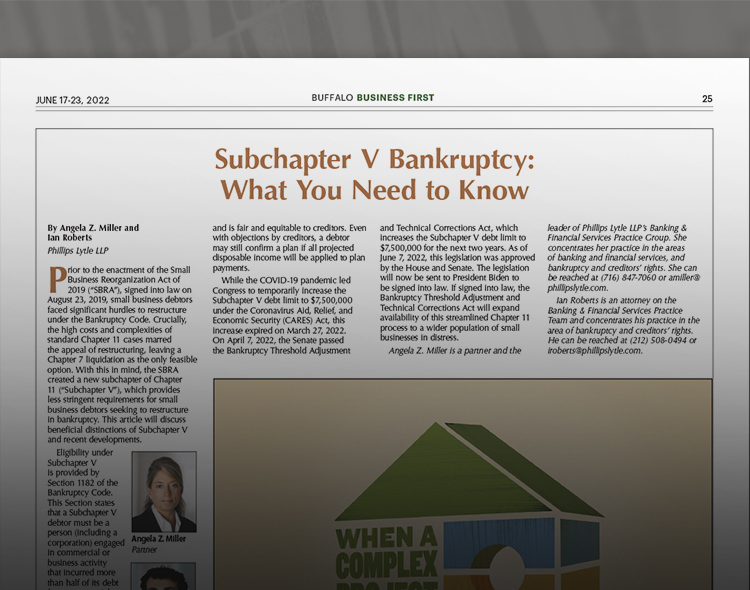



In 2019, Congress enacted the Small Business Reorganization Act of 2019 (“SBRA”), creating a new subchapter of Chapter 11 of the Bankruptcy Code (“Subchapter V”), which provides a more efficient and cost-effective path for small businesses to reorganize their debts through bankruptcy.
Subchapter V is faster and less complex than proceedings commenced under Chapter 11 of the Bankruptcy Code. One of the most attractive features of Subchapter V is that the owners of a business seeking to reorganize under this subchapter may retain their interests in the debtor, even if creditors object to the plan of reorganization. So long as all projected disposable income of the debtor will be applied to plan payments during the term of the plan, a debtor may confirm a plan over creditors’ objections while ownership retains their interests in the debtor. Indeed, a trend has emerged recently in certain jurisdictions where bankruptcy courts have confirmed reorganization plans under Subchapter V that incorporate a temporary stay of creditor actions against ownership (including, for example, actions on a personal guaranty) during the term of the reorganization plan.
While Subchapter V can offer a quick and inexpensive path to reorganization, there are certain eligibility requirements, including the debt threshold, that may bar small businesses from seeking relief under Subchapter V. When the SBRA was enacted, in order to be eligible to file for relief under Subchapter V, a debtor could not have indebtedness in excess of $3,024,725. During the COVID-19 pandemic, Congress temporarily increased this debt limit to $7,500,000 under the Coronavirus Aid, Relief, and Economic Security (“CARES”) Act. On June 21, 2024, the pandemic-era increase expired, and the debt threshold reverted back to the original $3,024,725 amount set forth in the SBRA, causing many businesses that may have otherwise been suitable candidates for reorganization under Subchapter V to be left with the more costly and time-consuming process under Chapter 11.
Efforts remain underway in Congress to revive the increased debt thresholds of Subchapter V and reopen eligibility for more small businesses. Presently, there is legislation pending in Congress in both the Senate (the Bankruptcy Threshold Adjustment Act of 2026 (S.3977)) and the House of Representatives (H.R. 7730) to restore and expand the Subchapter V thresholds. Both bills seek to, among other things, permanently reinstate the $7.5 million debt threshold originally introduced by the CARES Act, making it possible for more small businesses to be eligible for relief under Subchapter V. The Senate bill, S.3977, is sponsored by Sen. Chuck Grassley (R-IA), while the House companion bill, H.R. 7730, is sponsored by Rep. Ben Cline (R-VA), with bipartisan support from Democratic co-sponsors to both bills. At this time, there has been no vote on S.3977, but it has been placed on the Senate Legislative Calendar, allowing the bill to be eligible for floor consideration and a potential vote. The House bill emerged from committee on March 26, 2026 and is now eligible to be brought to the House floor for a vote. As of yet, nothing has been scheduled.
Distressed small businesses should stay aware of any legislative developments related to Subchapter V, as expanded debt thresholds could offer valuable relief for businesses that may not have previously been eligible to file under Subchapter V.
Catherine N. Cervone, Partner and member of the Bankruptcy and Creditors’ Rights Law Practice Group at Phillips Lytle LLP, can be reached at (716) 847-8323 or ccervone@phillipslytle.com.
Receive firm communications, legal news and industry alerts delivered to your inbox.
Subscribe Now